Important Information
This Summary of Safety and Clinical Performance (SSCP) is intended
to provide public access to an updated summary of the main aspects
of the safety and clinical performance of the device. The
information presented below is intended for patients or lay
persons. A more extensive summary of safety and clinical
performance prepared for healthcare professionals is found in the
first part of this document.
The SSCP is not intended to give general advice on the treatment
of a medical condition. Please contact your healthcare
professional in case you have questions about your medical
condition or about the use of the device in your situation. This
SSCP is not intended to replace an Implant Card or the
Instructions for Use to provide information on the safe use of the
device.
1. Device Identification and General Information
Device Trade Name(s): Hemo-Flow®, Jet Flow, Nipro
Flow
Manufacturer Name and Address: Medical
Components, Inc., 1499 Delp Drive, Harleysville, PA 19438 USA
Basic UDI-DI: 00884908101MG
Date First CE Certificate Was Issued for This Device:
February 2004
Device Grouping and Variants
The devices in scope of this document are all long-term
hemodialysis catheter sets. The device part numbers are organized
into variant categories. These devices are distributed as
procedure trays. Procedure trays come in different configurations.
Variant Devices:
Variant Devices:
| Variant Description |
Part Number(s) |
| 14.5F x 24cm Pre-Curved Hemo Flow |
10385-824-001C
10385-824-100C
10385-824-112C
|
| 14.5F x 24cm Straight Hemo Flow |
10385-824-001
10385-824-100
10385-824-112
|
| 14.5F x 28cm Pre-Curved Hemo Flow |
10385-828-001C
10385-828-100C
10385-828-112C
|
| 14.5F x 28cm Straight Hemo Flow |
10385-828-001
10385-828-100
10385-828-112
|
| 14.5F x 32cm Pre-Curved Hemo Flow |
10385-832-001C
10385-832-100C
10385-832-112C
|
| 14.5F x 32cm Straight Hemo Flow |
10385-832-001
10385-832-100
10385-832-112
|
| 14.5F x 36cm Pre-Curved Hemo Flow |
10385-836-001C
10385-836-112C
|
| 14.5F x 36cm Straight Hemo Flow |
10385-836-001
10385-836-100
10385-836-112
|
| 14.5F x 40cm Straight Hemo Flow |
10385-840-001
10385-840-100
|
| 14.5F x 55cm Straight Hemo Flow |
10385-855-001 |
Procedure Trays:
Procedure Trays:
| Catalog Code |
Part Number |
Description |
| HFS24E. |
10385-824-001 |
14.5F x 24cm Hemo-Flow® Catheter Set (Cuff 19cm From Tip)
|
| HFS28E. |
10385-828-001 |
14.5F x 28cm Hemo-Flow® Catheter Set (23cm From Tip)
|
| HFS32E. |
10385-832-001 |
14.5F x 32cm Hemo-Flow® Catheter Set (Cuff 27cm From Tip)
|
| HFS36E. |
10385-836-001 |
14.5F x 36cm Hemo-Flow® Catheter Set (Cuff 31cm From Tip)
|
| HFS40E. |
10385-840-001 |
14.5F x 40cm Hemo-Flow® Catheter Set (Cuff 35cm From Tip)
|
| HFS 55 |
10385-855-001 |
14.5F x 55cm Hemo-Flow® Catheter Set (Cuff 50cm From Tip)
|
| HFS24PCE. |
10385-824-001C |
14.5F x 24cm Pre-Curved Hemo-Flow® Catheter Set (Cuff 19cm
From Tip)
|
| HFS28PCE. |
10385-828-001C |
14.5F x 28cm Pre-Curved Hemo-Flow® Catheter Set (Cuff 23cm
From Tip)
|
| HFS32PCE. |
10385-832-001C |
14.5F x 32cm Pre-Curved Hemo-Flow® Catheter Set (Cuff 27cm
From Tip)
|
| HFS36PCE. |
10385-836-001C |
14.5F x 36cm Pre-Curved Hemo-Flow® Catheter Set (Cuff 31cm
From Tip)
|
| JFC1424 |
10385-824-100 |
14.5F x 24cm Jet Flow Catheter Set (Cuff 19cm From Tip)
|
| JFC1428 |
10385-828-100 |
14.5F x 28cm Jet Flow Catheter Set (Cuff 23cm From Tip)
|
| JFC1432 |
10385-832-100 |
14.5F x 32cm Jet Flow Catheter Set (Cuff 27cm From Tip)
|
| JFC1436 |
10385-836-100 |
14.5F x 36cm Jet Flow Catheter Set (Cuff 31cm From Tip)
|
| JFC1440 |
10385-840-100 |
14.5F x 40cm Jet Flow Catheter Set (Cuff 35cm From Tip)
|
| JFC1424PC |
10385-824-100C |
14.5F x 24cm Pre-Curved Jet Flow Catheter Set (Cuff 19cm
From Tip)
|
| JFC1428PC |
10385-828-100C |
14.5F x 28cm Pre-Curved Jet Flow Catheter Set (Cuff 23cm
From Tip)
|
| JFC1432PC |
10385-832-100C |
14.5F x 32cm Pre-Curved Jet Flow Catheter Set (Cuff 27cm
From Tip)
|
| NITDL24SK |
10385-824-112 |
14.5F x 24cm Nipro Flow Catheter Set (Cuff 19cm From Tip)
|
| NITDL28SK |
10385-828-112 |
14.5F x 28cm Nipro Flow Catheter Set (Cuff 23cm From Tip)
|
| NITDL32SK |
10385-832-112 |
14.5F x 32cm Nipro Flow Catheter Set (Cuff 27cm From Tip)
|
| NITDL36SK |
10385-836-112 |
14.5F x 36cm Nipro Flow Catheter Set (Cuff 31cm From Tip)
|
| NITDL24CK |
10385-824-112C |
14.5F x 24cm Pre-Curved Nipro Flow Catheter Set (Cuff 19cm
From Tip)
|
| NITDL28CK |
10385-828-112C |
14.5F x 28cm Pre-Curved Nipro Flow Catheter Set (Cuff 23cm
From Tip)
|
| NITDL32CK |
10385-832-112C |
14.5F x 32cm Pre-Curved Nipro Flow Catheter Set (Cuff 27cm
From Tip)
|
| NITDL36CK |
10385-836-112C |
14.5F x 36cm Pre-Curved Nipro Flow Catheter Set (Cuff 31cm
From Tip)
|
Configurations of Procedure Trays:
| Configuration Type |
| Hemo-Flow® Set |
| Hemo-Flow® Set (55cm Length) |
| Jet Flow Set Nipro Flow Set |
2. Intended Use of the Device
Intended Purpose: Hemo-Flow®/Jet Flow/Nipro Flow
Catheters are intended for use in adult patients who do not have
functional permanent vascular access or are not candidates for
permanent vascular access for whom central venous vascular access
for hemodialysis is deemed necessary based on the direction of a
qualified, licensed physician. The catheter is intended to be used
under the regular review and assessment of qualified health
professionals. This catheter is for single use only.
Indication(s): Hemo-Flow®/Jet Flow/Nipro Flow
catheters are indicated for short-term or long-term use where
vascular access is required for 14 days or more for the purpose of
hemodialysis.
Intended Patient Group(s): Hemo-Flow®/Jet
Flow/Nipro Flow Catheters are intended for use in adult patients
who do not have functional permanent vascular access or are not
candidates for permanent vascular access for whom central venous
vascular access for hemodialysis is deemed necessary based on the
direction of a qualified, licensed physician. The catheter is not
intended for use in pediatric patients.
Contraindications and/or Limitations:
-
Known or suspected allergies to any of the components of the
catheter or the kit.
-
This device is contraindicated for patients exhibiting severe,
uncontrolled coagulopathy or thrombocytopenia.
3. Device Description
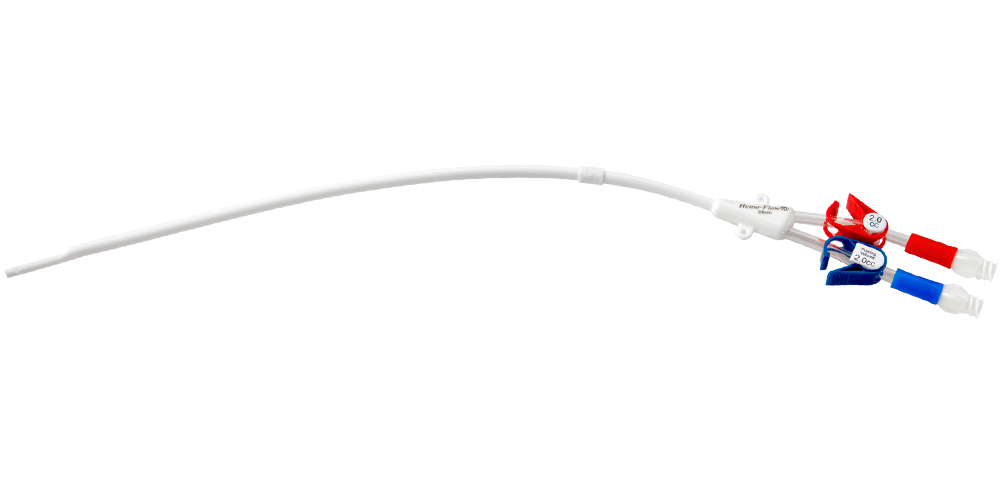
Device Name: Hemo-Flow®, Jet Flow, Nipro Flow
Description of Device: The Hemo-Flow® / Jet Flow
/ Nipro Flow Catheters are long-term catheters. The catheters are
double tubed. The catheters remove and return blood through two
separate lines. Each tube connects through an extension line. The
transition between lumen and extension is in a central hub. Each
tube has the priming volume marked by colored rings on the clamps
on the extensions. A polyester cuff on the catheter tubing helps
attach the catheter to the patient.
Materials / Substances in Contact with Patient Tissue:
The percentage ranges below are based on catheter weights. The
24cm catheter weighs 12.93 grams. The 55cm catheter weighs 17.48
grams.
| Material |
% Weight (w/w) |
| Polyurethane |
60.40 - 65.50 |
| Acetal co-polymer |
13.64 - 18.44 |
| Silicone |
5.81 - 7.85 |
| Acrylonitrile Butadiene Styrene |
4.32 - 5.85 |
| Barium sulfate |
5.03 - 8.93 |
| Polyethylene terephthalate |
1.81 - 2.44 |
Note:The device should not be used if you are allergic to the
above materials.
Note:Accessories containing stainless steel may contain up to 4%
weight of the CMR substance cobalt.
Information on Medicinal Substances in the Device:
N/A
How the Device Achieves its Intended Mode of Action:
Hemodialysis catheters are centrally placed access tubes. A
typical hemodialysis catheter uses a thin, flexible tube. The tube
has two openings. The tube goes into a large vein. The vein is
usually the internal jugular vein. Blood withdraws through one
lumen of the catheter. The blood flows to the dialysis machine
through a separate tubing set. The blood is then processed and
filtered. The blood returns to the patient through the second
lumen. This device is used when dialysis must start at once.
Patients may not have a functioning AV fistula or graft. Catheter
hemodialysis normally happens on a short-term basis. Long-term
access may occur in some cases. For example, when there are
problems supporting an AV fistula or graft.
Cleaning (Sterilization) Information: Contents
sterile and non-pyrogenic in unopened, undamaged package.
Sterilized by Ethylene Oxide.
Accessories Intended for Use in Combination with the
Device:
| Name of Accessory |
Description of Accessory |
| Guidewire |
Acts as a path for other components |
| Guidewire Advancer |
Helps guidewire introduction |
| Introducer Needle |
Placed into the target vein to gain access
|
| Tunneler |
Creates a pocket in between muscle and skin for catheter
|
| Tunneler Sleeve |
Helps secure catheter to tunneler |
| Peelable Introducer |
Used to get central venous access |
| End Cap |
To keep the catheter clean between treatments
|
| Dilator |
Used to make the opening of a vessel larger
|
| Scalpel |
A cutting device |
| Tegaderm |
Dressing that protects the catheter from contamination
|
| Syringe |
Helps get blood return once the needle punctures the vein
|
4. Risks and Warnings
Contact your healthcare professional if you believe you are
experiencing side-effects related to the device or its use.
Contact your healthcare professional if you are concerned about
risks. This document does not replace a consultation with your
healthcare professional.
How Potential Risks Have Been Controlled or Managed
There have been 511,182 devices sold since January 2020. There are
side effects and risks associated with the device. These include:
Infection
Bleeding
Catheter Removal
Catheter Replacement
These risks are reduced to an acceptable level. The labeling
describes the risks. The benefit of the device is access for
hemodialysis when alternatives are not suitable. These benefits
outweigh the risks.
Remaining Risks and Undesirable Effects
The Hemo-Flow® catheter is associated with risks. These include:
Procedural Delays
Thrombosis
Infections
Perforations
Embolism
Cardiac Event
Dissatisfaction
These risks are consistent with risks of other dialysis catheters.
They are not unique to the Medcomp product. Some of the most
common reactions include infection. Infection may be associated
with general surgical procedure and hospitalization. Infection may
not always be device-related.
|
Quantification of Residual Risks
|
|
PMS Complaints 01 January 2016 – 31 March 2025
|
PMCF Events |
|
Units Sold: 701,139 |
Units Studied: 183 |
|
Patient Residual Harm Category
|
# of Cases Per Event |
# of Cases Per Event |
| Allergic Reaction |
Not Reported. |
Not Reported |
| Bleeding |
1 Event in 110,000 Cases. |
1 Event in 26 Cases. |
| Cardiac Event |
1 Event in 100,000 Cases. |
1 Event in 91 Cases. |
| Embolism |
Not Reported |
1 Event in 183 Cases. |
| Infection |
Not Reported. |
1 Event in 9 Cases. |
| Perforation |
Not Reported. |
1 Event in 183 Cases. |
| Stenosis |
Not Reported. |
Not Reported |
| Tissue Injury |
Not Reported. |
Not Reported |
| Thrombosis |
Not Reported. |
1 Event in 16 Cases. |
Warnings and Precautions
To reduce the risk of bacteria entering the catheter, wear a mask
over your nose and mouth whenever the catheter is accessed.
Keep the catheter dressing clean and dry. The dressing should be
changed by a medical professional at each dialysis session.
Avoid letting the catheter or catheter site go under water.
Moisture near the catheter site can potentially lead to an
infection.
Ask the doctor to explain the signs and symptoms of catheter
infection.
Never remove the cap at the end of the catheter. The cap and
clamps of the catheter must be kept closed when not being used for
dialysis.
Summary of Any Field Safety Correction Action (FSCA)
There were no recalls for the device between 01 April 2024 to 31
March 2025
5. Summary of Clinical Evaluation and Post-Market Clinical
Follow-Up
Clinical Background of Device
The subject devices have been available since 2003. The CE Mark
was received in 2004. US FDA clearance was in 2003. All models
included are planned for distribution in the European Union.
Clinical Evidence for CE-Marking
The clinical literature review identified 6 articles relating to
the safety and/or performance of the subject device when used as
intended. These articles included approximately 1,822 cases. Four
patient level data activities received information on 183
catheters. 8 user surveys have been received relating to this
device. Findings from the clinical literature and data activities
support the performance of the subject device. All data on the
Hemo-Flow®/Jet Flow/Nipro Flow catheter has been evaluated. The
benefits of the subject device outweigh the risks when the device
is used as intended. The benefit of the device is allowing
hemodialysis in patients in whom other therapies or conservative
care are not desirable by the physician.
Safety
There is sufficient data to prove conformity to the applicable
requirements. The device is safe and performs as intended and
claimed by Medcomp. The device is state of the art for allowing
long-term vascular access for hemodialysis in adult patients.
Medcomp has reviewed:
Post-Market Data
Medcomp Information Materials
Risk Management Documentation The risks are appropriately
displayed and consistent with the state of the art. The risks
associated with the device are acceptable when weighed against the
benefits. There were 103 complaints for 511,182 units sold from 01
January 2020 to 31 March 2025. The complaint rate is 0.020%.
6. Possible Therapeutic Alternatives
When considering alternative treatments, it is recommended to
contact your healthcare professional who can consider your
individual situation. The Kidney Disease Outcomes Quality
Initiative (KDOQI) 2019 clinical practice guidelines have been
used to support the below recommendations for treatments.
| Therapy |
Benefits |
Disadvantages |
Key Risks |
| • AV Fistula |
- Permanent solution.
-
Lower complication rate than catheter.
|
- Requires time.
-
Patients must sometimes self-needle stick.
|
- Stenosis
- Thrombosis
- Aneurysm
- Pulmonary hypertension
- Steal Syndrome
- Septicemia
|
| • Hemodialysis Catheter |
- Useful for quick access.
-
Can be used as a bridge between therapies.
|
- Not permanent.
- Catheter dysfunction can happen.
-
Benefit may not be the same for everyone.
|
- Post-procedural bleeding
- Infection
- Thrombosis
-
Decreased blood flow in dysfunctional catheter
- Cardiovascular events
-
Fibrin sheath formation around catheter
- Septicemia
|
| • Peritoneal Dialysis |
-
Less restrictive diet than hemodialysis.
- Does not require hospitalization.
|
-
Clearance of impurities is limited by flow and space.
|
- Peritonitis
- Septicemia
- Fluid overload
|
| • Kidney Transplant |
- Better quality of life.
- Lower risk of death.
- Fewer dietary restrictions.
|
- Requires a donor.
- More risky for certain groups.
-
Patient must take medication for life.
- Medication has side effects.
|
- Thrombosis
- Hemorrhage
- Ureteral blockage
- Infection
- Organ rejection
- Death
- Myocardial infarction
- Stroke
|
| • Comprehensive Conservative Care |
- Less imposed symptom burden.
- Preserves life satisfaction.
|
- May aggravate clinical condition.
- Not designed to treat.
|
-
Treatment may not actually minimize risks associated
with CKD.
|
7. Suggested Profile and Training for Users
The catheter should be inserted, manipulated, and removed by a
qualified, licensed physician or other qualified health care
professional under the direction of a physician. In certain
circumstances, patients who may be suitable for home hemodialysis
may manipulate the external connections of the catheter. Consult
International Society of Hemodialysis guidelines. If home dialysis
is recommended, you will undergo thorough training. The objectives
of the training program are: 1) Give you information to dialyze
safely at home. 2) Enable you to monitor and manage your disease.
3) Help you cope with fears and restrictions of home hemodialysis.
The ideal nurse trainer-to-patient ratio is typically 1:1. A
training schedule will be created. Training will be individualized
to your needs.
Acronyms
| Abbreviation |
Definition |
| AV |
Arteriovenous |
| CE |
Conformité Européenne (European Conformity)
|
| CKD |
Chronic Kidney Disease |
| cm |
centimeter |
| CMR |
Carcinogenic, mutagenic, reprotoxic |
| dba |
Doing Business As |
| F |
French (thickness of catheter) |
| FDA |
Food and Drug Administration |
| FSCA |
Field Safety Corrective Action |
| KDOQI |
Kidney Disease Outcomes Quality Initiative
|
| PA |
Pennsylvania |
| SSCP |
Summary of Safety and Clinical Performance
|
| USA |
United States of America |
| w/w |
Weight over Weight |