Important Information
This Summary of Safety and Clinical Performance (SSCP) is intended
to provide public access to an updated summary of the main aspects
of the safety and clinical performance of the device. This SSCP is
not intended to replace the Instructions for Use as the main
document to ensure the safe use of the device, nor is it intended
to provide diagnostic or therapeutic suggestions to intended users
or patients.
Applicable Documents
| Document Type |
Document Title / Number |
| Design History File (DHF) |
96024 |
| ‘MDR Documentation’ File Number |
MDR-002 |
1. Device Identification and General Information
Device Trade Name(s): Hemo-Flow®, Jet Flow, Nipro
Flow
Manufacturer Name and Address: Medical
Components, Inc., 1499 Delp Drive, Harleysville, PA 19438 USA
Manufacturer Single Registration Number (SRN):
US-MF-000008230
Basic UDI-DI: 00884908101MG
Medical Device Nomenclature: F900202 – Permanent
Hemodialysis Catheter and Kits
Class of Device: III
Date First CE Certificate Issued: February 2004
Authorized Representative Name and SRN: European
Regulatory Expert Medical Product Service GmbH (MPS) Borngasse 20
35619 Braunfels, Germany SRN: DE-AR-000005009
Notified Body Name and Single Identification Number:
BSI Netherlands NB2797
Device Grouping and Variants
The devices in scope of this document are all long-term
hemodialysis catheter sets. The device part numbers are organized
into variant categories. These devices are distributed as
procedure trays, in various configurations inclusive of
accessories and adjunctive devices (see section “Accessories
intended for use in combination with the Device”).
Variant Devices:
Variant Devices:
| Variant Description |
Part Number(s) |
Explanation of Multiple Part Numbers |
| 14.5F x 24cm Pre-Curved Hemo Flow |
10385-824-001C
10385-824-100C
10385-824-112C
|
No significant clinical, biological, or technical difference
(only difference is branding)
|
| 14.5F x 24cm Straight Hemo Flow |
10385-824-001
10385-824-100
10385-824-112
|
No significant clinical, biological, or technical difference
(only difference is branding)
|
| 14.5F x 28cm Pre-Curved Hemo Flow |
10385-828-001C
10385-828-100C
10385-828-112C
|
No significant clinical, biological, or technical difference
(only difference is branding)
|
| 14.5F x 28cm Straight Hemo Flow |
10385-828-001
10385-828-100
10385-828-112
|
No significant clinical, biological, or technical difference
(only difference is branding)
|
| 14.5F x 32cm Pre-Curved Hemo Flow |
10385-832-001C
10385-832-100C
10385-832-112C
|
No significant clinical, biological, or technical difference
(only difference is branding)
|
| 14.5F x 32cm Straight Hemo Flow |
10385-832-001
10385-832-100
10385-832-112
|
No significant clinical, biological, or technical difference
(only difference is branding)
|
| 14.5F x 36cm Pre-Curved Hemo Flow |
10385-836-001C
10385-836-112C
|
No significant clinical, biological, or technical difference
(only difference is branding)
|
| 14.5F x 36cm Straight Hemo Flow |
10385-836-001
10385-836-100
10385-836-112
|
No significant clinical, biological, or technical difference
(only difference is branding)
|
| 14.5F x 40cm Straight Hemo Flow |
10385-840-001
10385-840-100
|
No significant clinical, biological, or technical difference
(only difference is branding)
|
| 14.5F x 55cm Straight Hemo Flow |
10385-855-001 |
N/A |
Procedure Trays:
Procedure Trays:
| Catalog Code |
Part Number |
Description |
| HFS24E. |
10385-824-001 |
14.5F x 24cm Hemo-Flow® Catheter Set (Cuff 19cm From Tip)
|
| HFS28E. |
10385-828-001 |
14.5F x 28cm Hemo-Flow® Catheter Set (23cm From Tip)
|
| HFS32E. |
10385-832-001 |
14.5F x 32cm Hemo-Flow® Catheter Set (Cuff 27cm From Tip)
|
| HFS36E. |
10385-836-001 |
14.5F x 36cm Hemo-Flow® Catheter Set (Cuff 31cm From Tip)
|
| HFS40E. |
10385-840-001 |
14.5F x 40cm Hemo-Flow® Catheter Set (Cuff 35cm From Tip)
|
| HFS 55 |
10385-855-001 |
14.5F x 55cm Hemo-Flow® Catheter Set (Cuff 50cm From Tip)
|
| HFS24PCE. |
10385-824-001C |
14.5F x 24cm Pre-Curved Hemo-Flow® Catheter Set (Cuff 19cm
From Tip)
|
| HFS28PCE. |
10385-828-001C |
14.5F x 28cm Pre-Curved Hemo-Flow® Catheter Set (Cuff 23cm
From Tip)
|
| HFS32PCE. |
10385-832-001C |
14.5F x 32cm Pre-Curved Hemo-Flow® Catheter Set (Cuff 27cm
From Tip)
|
| HFS36PCE. |
10385-836-001C |
14.5F x 36cm Pre-Curved Hemo-Flow® Catheter Set (Cuff 31cm
From Tip)
|
| JFC1424 |
10385-824-100 |
14.5F x 24cm Jet Flow Catheter Set (Cuff 19cm From Tip)
|
| JFC1428 |
10385-828-100 |
14.5F x 28cm Jet Flow Catheter Set (Cuff 23cm From Tip)
|
| JFC1432 |
10385-832-100 |
14.5F x 32cm Jet Flow Catheter Set (Cuff 27cm From Tip)
|
| JFC1436 |
10385-836-100 |
14.5F x 36cm Jet Flow Catheter Set (Cuff 31cm From Tip)
|
| JFC1440 |
10385-840-100 |
14.5F x 40cm Jet Flow Catheter Set (Cuff 35cm From Tip)
|
| JFC1424PC |
10385-824-100C |
14.5F x 24cm Pre-Curved Jet Flow Catheter Set (Cuff 19cm
From Tip)
|
| JFC1428PC |
10385-828-100C |
14.5F x 28cm Pre-Curved Jet Flow Catheter Set (Cuff 23cm
From Tip)
|
| JFC1432PC |
10385-832-100C |
14.5F x 32cm Pre-Curved Jet Flow Catheter Set (Cuff 27cm
From Tip)
|
| NITDL24SK |
10385-824-112 |
14.5F x 24cm Nipro Flow Catheter Set (Cuff 19cm From Tip)
|
| NITDL28SK |
10385-828-112 |
14.5F x 28cm Nipro Flow Catheter Set (Cuff 23cm From Tip)
|
| NITDL32SK |
10385-832-112 |
14.5F x 32cm Nipro Flow Catheter Set (Cuff 27cm From Tip)
|
| NITDL36SK |
10385-836-112 |
14.5F x 36cm Nipro Flow Catheter Set (Cuff 31cm From Tip)
|
| NITDL24CK |
10385-824-112C |
14.5F x 24cm Pre-Curved Nipro Flow Catheter Set (Cuff 19cm
From Tip)
|
| NITDL28CK |
10385-828-112C |
14.5F x 28cm Pre-Curved Nipro Flow Catheter Set (Cuff 23cm
From Tip)
|
| NITDL32CK |
10385-832-112C |
14.5F x 32cm Pre-Curved Nipro Flow Catheter Set (Cuff 27cm
From Tip)
|
| NITDL36CK |
10385-836-112C |
14.5F x 36cm Pre-Curved Nipro Flow Catheter Set (Cuff 31cm
From Tip)
|
Configurations of Procedure Trays:
| Configuration Type |
Kit Components |
| Hemo-Flow® Set |
(1) Catheter (1) 18GA Introducer Needle (1) 0.038" (0.97mm)
x 70cm Guidewire (1) Guidewire Advancer (1) Tunneler (1) 14F
Dilator (1) 15F Valved Peelable Introducer (1) Scalpel (2)
End Caps (1) Patient ID Card (1) Patient Information Packet
|
| Hemo-Flow® Set (55cm Length) |
1) Catheter (1) 18GA Introducer Needle (1) 0.038" (0.97mm) x
100cm Guidewire (1) Guidewire Advancer (1) Tunneler (1) 14F
Dilator (1) 15F Valved Peelable Introducer (1) Scalpel (2)
End Caps (1) Patient ID Card (1) Patient Information Packet
|
| Jet Flow Set Nipro Flow Set |
(1) Catheter (1) 18GA Introducer Needle (1) 0.038" (0.97mm)
x 70cm Guidewire (1) Guidewire Advancer (1) Tunneler (1) 14F
Dilator (1) 15F Valved Peelable Introducer (1) Scalpel (2)
End Caps (1) Patient ID Card (1) Patient Information Packet
|
2. Intended Use of the Device
Intended Purpose: Hemo-Flow®/Jet Flow/Nipro Flow
Catheters are intended for use in adult patients who do not have
functional permanent vascular access or are not candidates for
permanent vascular access for whom central venous vascular access
for hemodialysis is deemed necessary based on the direction of a
qualified, licensed physician. The catheter is intended to be used
under the regular review and assessment of qualified health
professionals. This catheter is for single use only.
Indication(s): Hemo-Flow®/Jet Flow/Nipro Flow
catheters are indicated for short-term or long-term use where
vascular access is required for 14 days or more for the purpose of
hemodialysis.
Target Population(s): Hemo-Flow®/Jet Flow/Nipro
Flow Catheters are intended for use in adult patients who do not
have functional permanent vascular access or are not candidates
for permanent vascular access for whom central venous vascular
access for hemodialysis is deemed necessary based on the direction
of a qualified, licensed physician. The catheter is not intended
for use in pediatric patients.
Contraindications and/or Limitations:
-
Known or suspected allergies to any of the components of the
catheter or the kit.
-
This device is contraindicated for patients exhibiting severe,
uncontrolled coagulopathy or thrombocytopenia.
3. Device Description
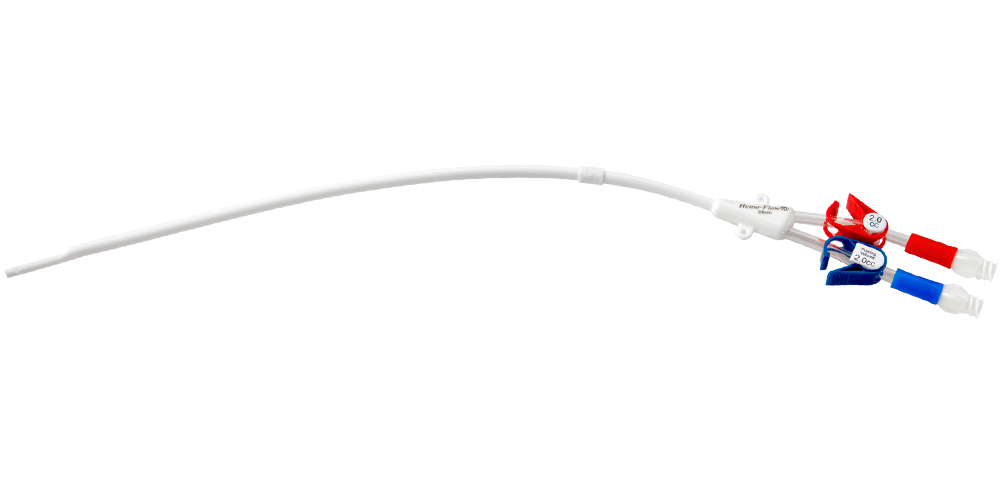
Device Name: Hemo-Flow®, Jet Flow, Nipro Flow
Description of Device: The Hemo-Flow®/Jet
Flow/Nipro Flow Catheter is a long-term double lumen, single
access catheter that is used to remove and return blood through
two separate passages (lumens). Each lumen is connected through an
extension line. The transition between lumen and extension is
housed within a molded hub. Each lumen has the priming volume
identified by identification rings assembled into the clamps on
the extensions. A polyester cuff is placed on the catheter’s lumen
for tissue ingrowth to anchor the catheter. The catheter
incorporates Barium Sulphate to facilitate visualization under
fluoroscopy or Xray. The catheter has been tested at flow rates of
up to 500 mL/min. The catheter is available in a variety of sizes
to accommodate physician preference and clinical needs.
Materials / Substances in Contact with Patient Tissue:
The percentage ranges in the table below are based on the weights
of the 24cm catheter (12.93g) and the 55cm catheter (17.48g).
| Material |
% Weight (w/w) |
| Polyurethane |
60.40 - 65.50 |
| Acetal co-polymer |
13.64 - 18.44 |
| Silicone |
5.81 - 7.85 |
| Acrylonitrile Butadiene Styrene |
4.32 - 5.85 |
| Barium sulfate |
5.03 - 8.93 |
| Polyethylene terephthalate |
1.81 - 2.44 |
Note:Per the instructions for use, the device is contraindicated
for patients with known or suspected allergies to the above
materials.
Note:Accessories containing stainless steel may contain up to 4%
weight of the CMR substance cobalt.
Information on Medicinal Substances in the Device:
N/A
How the Device Achieves its Intended Mode of Action:
Hemodialysis catheters are centrally placed access tubes. A
typical hemodialysis catheter uses a thin, flexible tube. The tube
has two openings. The tube goes into a large vein. The vein is
usually the internal jugular vein. Blood withdraws through one
lumen of the catheter. The blood flows to the dialysis machine
through a separate tubing set. The blood is then processed and
filtered. The blood returns to the patient through the second
lumen. This device is used when dialysis must start at once.
Patients may not have a functioning AV fistula or graft. Catheter
hemodialysis normally happens on a short-term basis. Long-term
access may occur in some cases. For example, when there are
problems supporting an AV fistula or graft.
Sterilization Information: Contents sterile and
non-pyrogenic in unopened, undamaged package. Sterilized by
Ethylene Oxide.
Previous Generations / Variants:
| Name of Previous Generation |
Differences from Current Device |
| N/A |
N/A |
Accessories Intended for Use in Combination with the
Device:
| Name of Accessory |
Description of Accessory |
| Guidewire |
For general intravascular use to facilitate the selective
placement of medical devices in the vessel anatomy.
|
| Guidewire Advancer |
Aid for introduction of guidewire into target vein.
|
| Introducer Needle |
Used for the percutaneous introduction of guidewires.
|
| Scalpel |
A cutting device during surgical, pathology and minor
medical procedures
|
| Tunneler |
Instrument used to create a subcutaneous tunnel
|
| Tunneler Sleeve |
Sleeve slides down the tunneler and over the catheter tip to
secure the catheter to the tunneler.
|
| Peelable Introducer |
Introducers are intended to obtain central venous access to
facilitate catheter insertion into the central venous
system.
|
| Dilator |
Designed for percutaneous entry into a vessel in order to
enlarge the opening of the vessel for the placement of a
catheter in a vein.
|
| End Cap |
To keep clean and protect catheter luer between treatments.
|
Other Devices or Products Intended for Use in Combination with
the Device:
| Name of Device or Product |
Description of Device or Product |
| Tegaderm |
Adhesive wound dressing intended to protect the catheter
from contamination when not in use
|
| Syringe |
Attached to introducer needle to help capture blood return
once introducer needle perforates targeted vein, prevent air
embolism
|
4. Risks and Warnings
Residual Risks and Undesirable Effects: All
surgical procedures carry risk. Medcomp has implemented risk
management processes to proactively find and mitigate these risks
as far as possible without adversely affecting the benefit-risk
profile of the device. After mitigation, residual risks and the
possibility of adverse events from use of this product remain.
Medcomp has determined that all residual risks are acceptable.
| Residual Harm Type |
Possible Adverse Events Associated with Harm
|
| Bleeding |
Bleeding (May be severe)
Femoral Artery Bleed
Hematoma
Retroperitoneal Bleed
|
| Cardiac Event |
Cardiac Arrhythmia
Cardiac Tamponade
|
| Embolism |
Air Embolus |
| Infection |
Bacteremia
Endocarditis
Exit Site Infection
Septicemia
Tunnel Infection
|
| Perforation |
Inferior Vena Cava Puncture
Laceration of the Vessel
Perforation of the Vessel
Pneumothorax
Right Atrial Puncture
Subclavian Artery Puncture
Superior Vena Cava Puncture
|
| Thrombosis |
Central Venous Thrombosis
Fibrin Sheath Formation
Lumen Thrombosis
Subclavian Vein Thrombosis
Vascular Thrombosis
|
| Miscellaneous Complications |
Brachial Plexus Injury
Femoral Nerve Damage
Hemothorax
Pleural Injury
Thoracic Duct Laceration
Venous Stenosis
|
|
Quantification of Residual Risks
|
|
PMS Complaints 01 January 2016 – 31 March 2025
|
PMCF Events |
|
Units Sold: 701,139 |
Units Studied: 183 |
|
Patient Residual Harm Category
|
% of Devices |
% of Devices |
| Allergic Reaction |
Not Reported |
Not Reported |
| Bleeding |
0.0009% |
3.83% |
| Cardiac Event |
0.0001% |
1.09% |
| Embolism |
Not Reported |
0.55% |
| Infection |
Not Reported |
10.38% |
| Perforation |
Not Reported |
0.55% |
| Stenosis |
Not Reported |
Not Reported |
| Tissue Injury |
Not Reported |
Not Reported |
| Thrombosis |
Not Reported |
6.01% |
Warnings and Precautions:
All warnings have been reviewed against the risk analysis, PMS,
and usability testing to validate consistency between the sources
of information. As per product IFUs for all brands (IFU 40769JBSI,
IFU 40769BSI, and IFU 40769NBSI), the Hemo-Flow® Catheters have
the following warnings:
-
Do not insert catheter in thrombosed vessels.
-
Do not advance the guidewire or catheter if unusual resistance
is encountered.
-
Do not insert or withdraw the guidewire forcibly from any
component. If the guidewire becomes damaged, guidewire and any
associated componentry must be removed together.
-
Do not resterilize the catheter or accessories by any method.
-
Contents sterile and non-pyrogenic in unopened, undamaged
package. STERILIZED BY ETHYLENE OXIDE
-
Do not re-use catheter or accessories as there may be a failure
to adequately clean and decontaminate the device which may lead
to contamination, catheter degradation, device fatigue, or
endotoxin reaction.
-
Do not use catheter or accessories if package is opened or
damaged.
-
Do not use catheter or accessories if any sign of product damage
is visible or the use-by date has passed.
-
Do not use sharp instruments near the extension tubing or
catheter lumen.
-
Do not use scissors to remove dressing. Precautions listed in
the Hemo-Flow® Catheter IFUs are as follows:
-
Examine catheter lumen and extensions before and after each
treatment for damage.
-
To prevent accidents, ensure the security of all caps and
bloodline connections prior to and between treatments.
-
Use only Luer Lock (threaded) Connectors with this catheter.
-
In the rare event that a hub or connector separates from any
component during insertion or use, take all necessary steps and
precautions to prevent blood loss or air embolism and remove the
catheter.
-
Before attempting catheter insertion, ensure that you are
familiar with the potential complications and their emergency
treatment should any of them occur.
-
Repeated overtightening of bloodlines, syringes, and caps will
reduce connector life and could lead to potential connector
failure.
-
The catheter will be damaged if clamps other than what is
provided with this kit are used.
-
Avoid clamping near the Luer Lock and hub of the catheter.
Clamping of the tubing repeatedly in the same location may
weaken tubing. Additional warnings and cautions listed in the
Hemo-Flow® Catheter IFUs are as follows:
-
The incidence of infection may be increased with femoral vein
insertion.
-
Do not pull tunneler out at an angle. Keep tunneler straight to
prevent damage to catheter tip.
-
DO NOT grasp and pull the guidewire prior to releasing the
J-Straightener. Damage to the guidewire may occur if it is
pulled against the restraint of the J-Straightener.
-
The length of the wire inserted is determined by the size of the
patient. Monitor patient for arrhythmia throughout this
procedure. The patient should be placed on a cardiac monitor
during this procedure. Cardiac arrhythmias may result if
guidewire is allowed to pass into the right atrium. The
guidewire should be held securely during this procedure.
-
Insufficient tissue dilation can cause compression of the
catheter lumen against the guidewire causing difficulty in the
insertion and removal of the guidewire from the catheter. This
can lead to bending of the guidewire.
-
The Valved Peelable Introducer is not designed for use in the
arterial system or as a hemostatic device.
-
DO NOT bend the sheath/dilator during insertion as bending will
cause the sheath to prematurely tear. Hold the introducer close
to the tip (approximately 3cm from tip) when initially inserting
through the skin surface. To progress the introducer towards the
vein, regrasp the introducer a few centimeters above the
original grasp location and push down on the introducer. Repeat
procedure until introducer is inserted to appropriate depth
based on patient anatomy and physician’s discretion.
-
Never leave sheath in place as an indwelling catheter. Damage to
the vein will occur.
-
Assure that all air has been aspirated from the catheter and
extensions. Failure to do so may result in air embolism.
-
Failure to verify catheter placement may result in serious
trauma or fatal complications.
-
Care must be taken when using sharp objects or needles in close
proximity to catheter lumen. Contact from sharp objects may
cause catheter failure.
-
Only clamp catheter with in-line clamps provided.
-
Extension clamps should only be open for aspiration, flushing,
and dialysis treatment.
-
Patients must not swim, shower, or soak dressing while bathing.
-
Always review hospital or unit protocol, potential complications
and their treatment, warnings, and precautions prior to
undertaking any type of mechanical or chemical intervention in
response to catheter performance problems.
-
Due to the risk of exposure to HIV (Human Immunodeficiency
Virus) or other blood borne pathogens, health care professionals
should always use Universal Blood and Body Fluid Precautions in
the care of all patients.
-
Always review hospital or unit protocol, potential complications
and their treatment, warnings, and precautions prior to catheter
removal.
-
Do not pull distal end of catheter through incision as
contamination of wound may occur.
Other Relevant Aspects of Safety: For a period of
01 January 2020 to 31 March 2025 there were 103 complaints for
511,182 units sold, giving an overall complaint rate of 0.020%.
There were no death-related events. No events resulted in recalls
during the review period.
5. Summary of Clinical Evaluation and Post-Market Clinical
Follow-Up (PMCF)
Summary of Clinical Data Related to Subject Device
Specific Case Numbers (Mixed Cohort Case Numbers) Identified and
Used for Clinical Performance Evaluation
| Product Family |
Clinical Literature |
PMCF Data |
Total Cases |
User Survey Responses |
| Hemo-Flow |
1,822 |
183 |
2,005 |
8 |
Clinical performance was measured using parameters including but
not limited to dwell time, catheter insertion outcomes, and
adverse event rates. Critical clinical parameters extracted from
these studies met standards set forth in the guidelines for the
State of the Art. There were no unforeseen adverse events or other
high occurrences of adverse events detected in any of the clinical
activities. Medcomp catheters are subjected to, and must pass,
simulated use testing intended to replicate use 3 times per week
for 12 months as part of device development. The Hemo-Flow®/Jet
Flow/Nipro Flow Catheter passed this testing. Although Medcomp
catheters contain no materials which degrade over time, fully
functional catheters may be removed for other reasons, such as
intractable infection, change of therapy (such as renal
replacement (transplant) or use of an arterio-venous
graft/fistula). Published clinical literature does not always
focus on the physical lifetime of a catheter for these reasons. In
the case of the Hemo-Flow®/Jet Flow/Nipro Flow Catheter, 48
catheters had a 236.6 day [95%CI: 165.4-307.9 days] duration of
use that has been found in clinical use reported to date. Based on
this information, the Hemo-Flow®/Jet Flow/Nipro Flow Catheter has
a 12-month lifetime; however, the decision to remove and/or
replace the catheter should be based on clinical performance and
need, and not any predetermined point in time.
Summary of Clinical Data Related to the Equivalent Device
Clinical evidence from published literature and PMCF activities
has been generated specific to known and unknown variants of the
subject device. The equivalency rationale in the updated clinical
evaluation report will demonstrate that the clinical evidence
available for these variants is representative of the range of
device variants in the device family. There are no clinical or
biological differences between variants within the subject device
family, and the potential impact of the technical differences will
be rationalized in the updated clinical evaluation report.
Summary of Clinical Data from Pre-Market Investigations (if
applicable)
No pre-market clinical devices were used for the device’s clinical
evaluation.
Summary of Clinical Data from Other Sources
Source:Summary of Published Literature
Clinical evidence literature searches have found six published
literature articles representing 1,753 Hemo-Flow® device family
specific cases and an additional 69 mixed cohort cases inclusive
of the Hemo-Flow® device family. The articles include one
randomized controlled trial (Hwang et al., 2012), four
retrospective studies (Forauer et al., 2009; Parvulescu et al.,
2021; Abd El-Hameed and Abdelhamid, 2022; Ulusan et al., 2024),
and one case study (Wu et al., 2021).
Bibliography:
Abd El-Hameed, A. R., & Abdelhamid, W. A. R. (2022).
Challenging, Safe, and Effective Use of External Iliac Vein for
Insertion of Tunneled Cuffed Hemodialysis Catheters: A
Single-Center Prospective Study. International Journal of
Nephrology, 2022((Abd El-Hameed A.R.,
arelsayed@medicine.zu.edu.eg; Abdelhamid W.A.R.,
waabdelhamid@medicine.zu.edu.eg) Department of Internal Medicine,
Zagazig University, Zagazig, Egypt). Embase.
https://doi.org/10.1155/2022/4576781
Forauer, A., McNulty, N., & Thomas, M. (2009). Tunneled
Hemodialysis Catheter Outcomes in Elderly Patients. J Vasc Interv
Radiol, 20, 467 - 471. doi:10.1016/j.jvir.2009.01.013
Hwang, H. S., Kang, S. H., Choi, S. R., Sun, I. O., Park, H. S.,
& Kim, Y. (2012). Comparison of the palindrome vs. step-tip
tunneled hemodialysis catheter: a prospective randomized trial.
Semin Dial, 25(5), 587-591. doi:10.1011/j.1525-139X.2012.01054.x
Parvulescu, Flavius; Oliver, Matthew J; Reyna, Myrtha E; Pugash,
Robyn; David, Elizabeth; (2021). Factors Affecting Cuff Extrusion
of Tunneled Hemodialysis Catheters #journal#, (#issue#),
08465371211041241
Ulusan, M., Meltem, E., Mutlu, I. N., & Ulusan, K. (2024). The
predictive value of systemic inflammatory markers in 902 patients
with tunneled hemodialysis catheter. Journal of Nephrology, 1-9.
Wu, Huizhen; Behera, Tapas Ranjan; Attia, Doaa; Yu, Xiaoling;
Shen, Quanquan; (2021). Retrieval of fractured dialysis catheter
through phlebotomy of internal jugular vein: a case report
#journal#, 49(#issue#), 0300060521998891
Source:LTHD Data Collection Survey Report
The Long-Term Hemodialysis Catheter Data Collection Survey was
intended to gather safety and performance outcome information from
sites that purchase Medcomp long-term hemodialysis catheters for
use in EU MDR clinical evaluation. Responses were requested to be
completed by physicians or other site employees with oversight and
direction from a physician. The surveys were distributed globally
to existing Medcomp customers. Responses were collected from
twenty-one sites, spanning nine countries (Colombia, Croatia, El
Salvador, Greece, Italy, Netherlands, Panama, Uruguay, and USA)
across North America, South/Latin America, and Europe. At least
partial data was collected on 48 Hemo-Flow® catheter product
family cases totalling 11,357 catheter days. Of these 48 cases, 33
cases were described as 14.5F x 28cm Hemo-Flow® catheters and 15
cases were described as 14.5F x 32cm Hemo-Flow® catheters.
Information was collected on Insertion Success (100%, n=48) and
dwell time (mean 236.6 days, 95% CI: 165.3 – 307.9, n=48). There
were no reports of catheter related blood stream infection, tunnel
infection, exit site infection, or catheter associated venous
thrombus. These outcomes were concluded to be within State of the
Art safety and performance outcome measures from published
literature.
• Source:PMCF_LTHD_213
The Damanhour Medical National Institute database was acquired to
gather safety and performance outcome information on Titan HD and
Hemo-Flow catheters for use in EU MDR clinical evaluation. These
outcome measures include procedural outcomes, dwell time,
incidences of thrombosis, and incidences of infection. 34
Hemo-Flow® cases, all described as 14.5F x 24cm, were collected.
The following outcome measures were confirmed to be within State
of the Art safety and performance outcome measures from published
literature for Medcomp Hemo-Flow catheters:
Dwell Time - 118.7 days (95%CI: 92.8 – 144.6)
Procedural Outcomes – 100%
Catheter Related Blood Stream Infection - 2.04 per 1,000 catheter
days (95%CI: 0.63 – 3.46)
Tunnel Infection - 0.25 per 1,000 catheter days (95%CI: 0 – 0.76)
Exit Site Infection – No Events Reported
Catheter Associated Venous Thrombus - 1.78 per 1,000 catheter days
(95%CI: 0.46 – 3.11)
• Source:PMCF_Medcomp_211
The Medcomp User Survey acquired responses from healthcare
personnel familiar with any number of Medcomp’s product offerings.
28 respondents responded that they or their facility have used
Medcomp long-term hemodialysis catheters, with 8 of those
respondents using the Hemo-Flow device. There were no differences
in mean user sentiments within long-term hemodialysis catheters
across State of the Art Performance and Safety Outcome Measures or
between device types relating to safety or performance. The
following data points were collected from users of Medcomp
long-term hemodialysis catheters (n=28):
(Mean Likert Scale Response) Catheters function as intended – 4.8
/ 5
(Mean Likert Scale Response) Packaging allows for aseptic
presentation – 4.8 / 5
(Mean Likert Scale Response) Benefit outweighs the risk – 4.7 / 5
Dwell Time (n=26) – 167 days (95%CI: 130 – 203) The following data
points were collected from users of Medcomp Hemo-Flow catheters
(n=8):
(Mean Likert Scale Response) Catheters function as intended – 4.7
/ 5
(Mean Likert Scale Response) Packaging allows for aseptic
presentation – 5 / 5
(Mean Likert Scale Response) Benefit outweighs the risk – 4.5 / 5
Dwell Time (n=7) – 157.7 days (95%CI: 109.2 – 206.3)
• Source:PMCF_Infusion_211
The Infusion Product Line Data Collection Survey aimed to assess
safety and performance outcome information for all variants of
Medcomp Infusion Ports, PICCs, Midlines, and CVCs. 70 survey
responses were collected from 17 countries representing 471 device
cases. 3 Hemo-Flow® cases inclusive of several variant devices
across length (28cm and 40cm) were collected. The following
outcome measures were collected for Medcomp Hemo-Flow devices:
Procedural Outcomes – 100%
Catheter Related Blood Stream Infection – No Events Reported
Catheter Associated Venous Thrombus – No Events Reported
Exit Site Infection – No Events Reported
• Source:PMCF_LTHD_242
The Long-Term Hemodialysis (LTHD) Truveta data analysis assessed
safety and performance outcome information for Medcomp® and
competitor devices present in Truveta Studio. Truveta data comes
from a growing collective of more than 30 health systems that
provide 17% of the daily clinical care across all 50 U.S. states
from 800 hospitals and 20,000 clinics, representing the full
diversity of the United States. The population used for data
analysis was derived utilizing Truveta Studio’s proprietary coding
language (Prose) and unique device identifier (UDI) codes
representing all saleable Medcomp® LTHD devices and LTHD devices
distributed and/or manufactured by other companies. 98 Hemo-Flow®
cases inclusive of several variant devices were collected. Cases
were described as 14.5F and Pre-Curved and Straight Cases,
configurations (straight, pre-curved), and lengths (24cm, 28cm,
32cm, 55cm), representation of 24cm, 28cm, 32cm and 55cm length
catheters. The following State of the Art safety and performance
outcome measures were observed for Medcomp Hemo-Flow® devices:
Catheter Related Blood Stream Infection – 1.7 per 1,000 catheter
days (95%CI: 0.95 – 2.81)
Catheter Associated Venous Thrombus – 0.34 per 1,000 catheter days
(95%CI: 0.07 – 0.99)
Exit Site Infection – 0.34 per 1,000 catheter days (95%CI: 0.07 –
0.99)
Tunnel Infection – 0 per 1,000 catheter days (95%CI: 0 – 0.42)
Dwell Time – 195 days (95%CI: 1.92 – 388.08)
The catheter brand logistic regression model did not find that any
Medcomp® catheter brands were statistically significantly
associated with an increase of the incidence of CRBSI. The brand
agnostic logistic regression found that pediatric age group (0–19
years), femoral vein insertion site, catheters that were the
fourth or beyond in sequence for a given patient, split-tip
designs, and pre-curved configurations were statistically
significantly associated with the incidence of CRBSI. The Split
Cath® III was associated with a statistically significant decrease
in CRBSI incidence in the brand model (OR: 0.46 95%CI: 0.33 -
0.63), and both shorter catheter length (<=24cm) and smaller
French size (<14.5F) in the brand agnostic model.
Overall Summary of Clinical Safety and Performance
Upon review of the Hemo-Flow® catheter data across all sources, it
is possible to conclude that the benefits of the subject device
outweigh the overall and individual risks when the device is used
as intended by the manufacturer. It is the manufacturer’s and
clinical expert evaluator’s opinion that activities both complete
and ongoing are sufficient to support the safety, efficacy, and
acceptable benefit/risk profile of the subject devices.
| Outcome |
Benefit/Risk Acceptability Criteria |
Desired Trend |
Clinical Literature (Subject Device) |
PMCF Data (Subject Device) |
| Performance Outcomes |
| Dwell Time |
Greater than 40 days |
+
|
137.4 days – 163 days (Summary of Published Literature)
|
236.6 days (LTHD Data Collection Survey Report) 118.7 days
(PMCF_LTHD_213) 157.7 days (PMCF_Medcomp_211) Likert Scale
Response 4.5 / 5 (PMCF_Medcomp_211)* 195 days
(PMCF_LTHD_242)
|
| Procedural Outcomes |
Greater than 93.3% |
+
|
100% (Summary of Published Literature)
|
100% (LTHD Data Collection Survey Report &
PMCF_LTHD_213) Likert Scale Response 4.6 / 5
(PMCF_Medcomp_211)*
|
| Safety Outcomes |
|
Catheter Related Blood Stream Infection (CRBSI)
|
Less than 4.8 incidents of CRBSI per 1,000 catheter days
|
-
|
0.48 – 3 per 1,000 catheter days (Summary of Published
Literature)
|
0 per 1,000 catheter days (LTHD Data Collection Survey
Report) 2.04 per 1,000 catheter days (PMCF_LTHD_213) Likert
Scale Response 4.2 / 5 (PMCF_Medcomp_211)* 1.7 per 1,000
catheter days (PMCF_LTHD_242)
|
| Tunnel Infection Rate |
Less than 2.8 incidents of tunnel infection per 1,000
catheter days
|
-
|
1.0 – 2.36 per 1,000 catheter days (Summary of Published
Literature)
|
No Events Reported (LTHD Data Collection Survey Report) 0.25
per 1,000 catheter days (PMCF_LTHD_213) Likert Scale
Response 4.3 / 5 (PMCF_Medcomp_211)* 0 per 1,000 catheter
days (PMCF_LTHD_242)
|
| Exit Site Infection Rate |
Less than 3.2 incidents of exit site infection per 1,000
catheter days
|
-
|
1.0 per 1,000 catheter days (Summary of Published
Literature)
|
No Events Reported (LTHD Data Collection Survey Report &
PMCF_LTHD_213) Likert Scale Response 4.1 / 5
(PMCF_Medcomp_211)* 0.34 per 1,000 catheter days
(PMCF_LTHD_242)
|
|
Catheter Associated Venous Thrombus (CAVT)
|
Less than 3.04 incidents of CAVT per 1,000 catheter days
|
-
|
0.51 - 0.64 per 1,000 catheter days (Summary of Published
Literature)
|
No Events Reported (LTHD Data Collection Survey Report) 1.78
per 1,000 catheter days (PMCF_LTHD_213) Likert Scale
Response 4.3 / 5 (PMCF_Medcomp_211)* 0.34 per 1,000 catheter
days (PMCF_LTHD_242)
|
*:PMCF_Medcomp_211 asked respondents, if they agreed on a scale
of 1 -5, that their experience in relation to each outcome was the
same or better than the benefit/risk acceptability criteria.
On-going or Planned Post-Market Clinical Follow-Up (PMCF)
| Activity |
Description |
Reference |
Timeline |
|
Multi-center Patient-Level Case Series
|
Collect additional clinical data on the device by acquiring
case data healthcare personnel familiar with the device.
|
PMCF_LTHD_241 |
Q4 2025 |
| State of the Art Literature Search |
Identify risks and trends with use of similar devices by
reviewing applicable standards, published literature,
conference abstracts, guidance documents and
recommendations; information relating to the medical
condition managed by the device and medical alternatives
available for the same target treated population.
|
SAP-HD |
Q2 2026 |
| Clinical Evidence Literature Search |
Identify risks and trends with use of the device by
reviewing any clinical data relevant to the device from
published literature.
|
LRP-HD |
Q2 2026 |
| Global Trial Database Search |
Identify ongoing clinical trials involving Hemo-Flow®
catheters.
|
N/A |
Q2 2026 |
No emerging risks, complications or unexpected device failures
have been detected from PMCF activities.
6. Possible Therapeutic Alternatives
The Kidney Disease Outcomes Quality Initiative (KDOQI) 2019
clinical practice guidelines have been used to support the below
recommendations for treatments.
| Therapy |
Benefits |
Disadvantages |
Key Risks |
| • AV Fistula |
-
Permanent vascular access solution
-
Lower complication rate than hemodialysis via catheter
|
- Requires time to mature
-
Patients must sometimes self-cannulate
|
- Stenosis
- Thrombosis
- Aneurysm
- Pulmonary hypertension
- Steal Syndrome
- Septicemia
|
| • Hemodialysis Catheter |
- Useful for quick access.
- without AV Fistula in place
-
Can be used as a bridge dialysis method between other
therapies
|
- Not a permanent solution
-
Catheter dysfunction can disrupt regular treatment
-
Benefit is not equal for all patient populations
|
- Post-procedural bleeding
- Infection
- Thrombosis
-
Decreased blood flow in dysfunctional catheter
- Cardiovascular events
-
Fibrin sheath formation around catheter
- Septicemia
|
| • Peritoneal Dialysis |
-
Less restrictive diet than hemodialysis
-
Does not require hospitalization, can be done in any
clean place
|
-
Clearance of impurities is limited by dialysate flow and
peritoneal area
|
- Peritonitis
- Septicemia
- Fluid overload
|
| • Kidney Transplant |
-
Better quality of life compared to HD
-
Lower risk of death compared to HD
-
Fewer dietary restrictions compared to HD
|
-
Requires a donor which can take time
-
More risky for certain groups (aged, diabetics, etc.)
-
Patient must take rejection medication for life
-
Rejection medication has side effects
|
- Thrombosis
- Hemorrhage
- Ureteral blockage
- Infection
- Organ rejection
- Death
- Myocardial infarction
- Stroke
|
| • Comprehensive Conservative Care |
-
Less imposed symptom burden than dialysis
- Preserves life satisfaction
|
- May aggravate clinical condition
-
Not designed to treat, but to minimize adverse events
|
-
Treatment may not actually minimize risks associated
with CKD
|
7. Suggested Profile and Training for Users
The catheter should be inserted, manipulated, and removed by a
qualified, licensed physician or other qualified health care
professional under the direction of a physician. In certain
circumstances, patients who may be suitable for home hemodialysis
may manipulate the external connections of the catheter. As per
guidelines stated from the International Society of Hemodialysis,
if home dialysis is recommended, each patient will undergo a
thorough training in order to obtain optimal results from home
dialysis treatments. The objectives of the training program are to
(1) provide the appropriate amount of information to ensure that
the patient will be able to dialyze safely at home; (2) enable the
patient to monitor and manage other elements of his or her chronic
kidney disease, such as obtaining samples for lab work and
maintaining appropriate nutrition and diet; and (3) help the
patient and his or her care partner(s) cope with barriers and
fears associated with home HD During training, the patient will
also receive technical education on the operations and maintenance
of the water treatment system. During training, the ideal nurse
trainer-to-patient ratio is typically 1:1. An idealized schedule
of training is created, with weekly areas of focus and training
objectives. In practice, however, training is individualized to
address any identified learning barriers or risks for failure.
8. Reference to Any Harmonized Standards and Common Specifications
(CS) Applied
| Harmonized Standard or CS |
Revision |
Title or Description |
Level of Compliance |
| EN ISO 14971 |
2019+A11:2021 |
Medical devices. Application of risk management to medical
devices
|
Full |
| EN ISO 10555-1 |
2013+A1:2017 |
Intravascular catheters. Sterile and single-use catheters.
General requirements
|
Full |
| ISO 10555-3 |
2013 |
Intravascular catheters. Sterile and single-use catheters.
Central venous catheters
|
Full |
| EN ISO 11607-1 |
2020+A1:2023 |
Packaging for terminally sterilized medical devices.
Requirements for materials, sterile barrier systems and
packaging systems
|
Full |
| EN ISO 11607-2 |
2020+A1:2023 |
Packaging for terminally sterilized medical devices.
Validation requirements for forming, sealing and assembly
processes
|
Full |
| MEDDEV 2.7/1 |
Rev 4 |
Clinical Evaluation: A Guide for Manufacturers and Notified
Bodies Under Directives 93/42/EEC and 90/385/EEC
|
Full |
| MEDDEV 2.12/2 |
Rev. 2 |
GUIDELINES ON MEDICAL DEVICES POST MARKET CLINICAL FOLLOW-UP
STUDIES A GUIDE FOR MANUFACTURERS AND NOTIFIED BODIES
|
Full |
| EN ISO 14155 |
2020 |
Clinical investigation of medical devices for human subjects
— Good clinical practice
|
Full |
| MDCG 2020-6 |
2020 |
Clinical evidence needed for medical devices previously CE
marked under Directives 93/42/EEC or 90/385/EEC
|
Full |
| MDCG 2020‑7 |
2020 |
Post-market clinical follow-up (PMCF) Plan Template A guide
for manufacturers and notified bodies
|
Full |
| MDCG 2020‑8 |
2020 |
Post-market clinical follow-up (PMCF) Evaluation Report
Template A guide for manufacturers and notified bodies
|
Full |
| MDCG 2022-9 |
2022 |
Summary of safety and clinical performance
|
Full |
| MDCG 2022-21 |
2022 |
Guidance on Periodic Safety Update Report (PSUR) According
to Regulation EU 2017/745 (MDR)
|
Full |
| ISO 10993-1 |
2020 |
Biological evaluation of medical devices — Part 1:
Evaluation and testing within a risk management process
|
Full |
| ISO 10993-18 |
2020+A1:2023 |
Biological evaluation of medical devices — Part 18: Chemical
characterization of medical device materials within a risk
management process
|
Full |
| EN ISO 10993-7 |
2008+ A1:2022 |
Biological evaluation of medical devices — Part 7: Ethylene
oxide sterilization residuals — Amendment 1: Applicability
of allowable limits for neonates and infants
|
Full |
| EN ISO 11135 |
2014 + A1: 2019 |
Sterilization of health-care products. Ethylene oxide.
Requirements for the development, validation and routine
control of a sterilization process for medical devices
|
Full |
| ISO 14644-1 |
2015 |
Cleanrooms and associated controlled environments — Part 1:
Classification of air cleanliness by particle concentration
|
Full |
| ISO 14644-2 |
2015 |
Cleanrooms and associated controlled environments — Part 2:
Monitoring to provide evidence of cleanroom performance
related to air cleanliness by particle concentration
|
Full |
| EN 556-1 |
2024 |
Sterilization of medical devices. Requirements for medical
devices to be designated "STERILE". Requirements for
terminally sterilized medical devices
|
Full |
| EN ISO 11737-1 |
2018 + A1: 2021 |
Sterilization of health care products. Microbiological
methods. Determination of a population of microorganisms on
products
|
Full |
| EN 11737-3 |
2023 |
Sterilization of health care products. Microbiological
methods — Bacterial endotoxin testing
|
Full |
| EN ISO 20417 |
2021 |
Medical Devices - Information supplied by the manufacturer
|
Full |
| EN ISO 15223-1 |
2021 |
Medical devices — Symbols to be used with medical device
labels, labelling and information to be supplied — Part 1:
General requirements
|
Full |
| EN 62366-1 |
2015 + A1: 2020 |
Medical devices — Part 1: Application of usability
engineering to medical devices
|
Full |
| ASTM D4332 |
2022 |
Standard Practice for Conditioning Containers, Packages, or
Packaging Components for Testing
|
Full |
| ASTM F2503-20 |
2020 |
Standard Practice for Marking Medical Devices and Other
Items for Safety in the Magnetic Resonance Environment
|
Full |
| ASTM F2503 |
2023e1 |
Standard Practice for Marking Medical Devices and Other
Items for Safety in the Magnetic Resonance Environment
|
Full |
| EN ISO 11070 |
2014+A1:2018 |
Sterile single-use intravascular introducers, dilators and
guidewires
|
Full |
| ISO 594-1 |
1986 |
Conical fittings with a 6 % (Luer) taper for syringes,
needles and certain other medical equipment — Part 1:
General requirements
|
Full |
| ISO 594-2 |
1998 |
Conical fittings with a 6 % (Luer) taper for syringes,
needles and certain other medical equipment — Part 2: Lock
Fittings
|
Full |
| ASTM D4169 |
2023e1 |
Standard Practice for Performance Testing of Shipping
Containers and Systems
|
Full |
| EN ISO 13485 |
2016 + A11: 2021 |
Medical Devices – Quality Management system – Requirements
for Regulatory Purposes
|
Full |
| PD CEN ISO/TR 20416 |
2020 |
Medical devices — Post-market surveillance for manufacturers
|
Full |
| MDCG 2018-1 |
Rev. 4 |
Guidance on BASIC UDI-DI and changes to UDI-DI
|
Full |
| EN ISO 11140-1 |
2014 |
Sterilization of health care products — Chemical indicators
Part 1: General requirements
|
Full |
| EN ISO/IEC 17025 |
2017 |
General requirements for the competence of testing and
calibration laboratories
|
Full |
| Regulation (EU) 2017/745 |
2017 |
Regulation (EU) 2017/745 of the European Parliament and of
the Council
|
Full |
| EN 17141 |
2020 |
Cleanrooms and associated controlled environments.
Biocontamination control
|
Full |
| ANSI/AAMI ST72 |
2019 |
Bacterial endotoxins-Test methods, routine monitoring, and
alternatives to batch testing
|
Full |
| EN ISO 80369-7 |
2021 |
Small-bore connectors for liquids and gases in healthcare
applications — Connectors for intravascular or hypodermic
applications
|
Full |
Revision History
| Revision |
Date |
CR# |
Author |
Description of Changes |
Validated |
| 1 |
04OCT2021 |
26534 |
RS |
Implementation of SSCP |
No, this version was not validated by the Notified Body as
this is a Class IIa or IIb implantable device
|
| 2 |
21JUN2022 |
27030 |
RS |
Scheduled Update; updated SSCP in accordance with CER-002_C.
In addition, the following elements were added throughout,
Basic UDI-DI, SRN, Notified Body name and single
identification number, EMDN nomenclature, quantification of
residual risks, benefits and risks related to alternative
therapies, required training for home hemodialysis, and
acronym table.
|
Yes, this version was validated by the Notified Body in the
following language: English
|
| 3 |
21JUN2023 |
28223 |
GM |
Periodic Update; Updated in Accordance with CER-002,
Revision D
|
Yes, this version was validated by the Notified Body in the
following language: English
|
| 4 |
07JUN2024 |
29150 |
GM |
Periodic Update; Updated in Accordance with CER-002,
Revision E
|
No, this version was not validated by the Notified Body as
this is a Class IIa or IIb implantable device
|
| 5 |
25JUN2025 |
25-0008 |
GM |
Periodic Update; Updated in Accordance with CER-002,
Revision F
|
No, this version was not validated by the Notified Body as
this is a Class IIa or IIb implantable device
|