Important Information
This Summary of Safety and Clinical Performance (SSCP) is intended
to provide public access to an updated summary of the main aspects
of the safety and clinical performance of the device. The
information presented below is intended for patients or lay
persons. A more extensive summary of safety and clinical
performance prepared for healthcare professionals is found in the
first part of this document.
The SSCP is not intended to give general advice on the treatment
of a medical condition. Please contact your healthcare
professional in case you have questions about your medical
condition or about the use of the device in your situation. This
SSCP is not intended to replace an Implant Card or the
Instructions for Use to provide information on the safe use of the
device.
1. Device Identification and General Information
Device Trade Name(s): Duo-Flow® Catheter
Manufacturer Name and Address: Medical
Components, Inc. 1499 Delp Drive Harleysville, PA 19438 USA
Basic UDI-DI: 00884908294NN
Date First CE Certificate Was Issued for This Device:
March 2001
Device Grouping and Variants
This document talks about hemodialysis tubes [catheter] sets.
These tubes are used for a short time and come in different sets.
These devices are distributed as procedure trays. Procedure trays
come in different configurations.
Variant Devices:
Variant Devices:
| Variant Description |
Part Number(s) |
| 11.5F x 12cm Raulerson IJ Duo-Flow |
1072 |
|
11.5F x 12cm Pre-Curved Duo-Flow w/ 2 Suture Wings
|
1365 |
| 11.5F x 12cm Straight Duo-Flow |
1020 |
| 11.5F x 13.5cm Raulerson IJ Duo-Flow |
10541 |
| 11.5F x 15cm Pre-Curved Duo-Flow |
1316 |
|
11.5F x 15cm Pre-Curved Duo-Flow w/ 2 Suture Wings
|
1362 |
| 11.5F x 15cm Raulerson IJ Duo-Flow |
1073
1880-815-405
|
| 11.5F x 15cm Straight Duo-Flow |
1021
1879-815-405
|
| 11.5F x 20cm Raulerson IJ Duo-Flow |
1074
1880-820-405
|
|
11.5F x 20cm Pre-Curved Duo-Flow w/ 2 Suture Wings
|
1363 |
| 11.5F x 20cm Straight Duo-Flow |
1022
1879-820-405
|
| 11.5F x 24cm Straight Duo-Flow |
1023
1879-824-405
|
| 9F x 12cm Pre-Curved Duo-Flow |
1336 |
| 9F x 12cm Straight Duo-Flow |
1064
1358
|
| 9F x 15cm Pre-Curved Duo-Flow |
1337 |
| 9F x 15cm Straight Duo-Flow |
1065
1353
|
| 9F x 20cm Pre-Curved Duo-Flow |
1338 |
| 9F x 20cm Straight Duo-Flow |
1066
1357
|
Procedure Trays:
Procedure Trays:
| Catalog Code |
Part Number |
Description |
| XTP114CT |
1020 |
11.5F X 12cm Duo-Flow® Double Lumen Hemodialysis Catheter
Only Set
|
| XTP114IJC |
1072 |
11.5F X 12cm Duo-Flow® Double Lumen IJ Hemodialysis Catheter
Only Set
|
| XTP116CT |
1021 |
11.5F X 15cm Duo-Flow® Double Lumen Hemodialysis Catheter
Only Set
|
| XTP116IJC |
1073 |
11.5F X 15cm Duo-Flow® Double Lumen IJ Hemodialysis Catheter
Only Set
|
| XTP118CT |
1022 |
11.5F X 20cm Duo-Flow® Double Lumen Hemodialysis Catheter
Only Set
|
| XTP118IJC |
1074 |
11.5F X 20cm Duo-Flow® Double Lumen IJ Hemodialysis Catheter
Only Set
|
| XTP119CT |
1023 |
11.5F X 24cm Duo-Flow® Double Lumen Hemodialysis Catheter
Only Set
|
| DJIJ116 |
1880-815-405 |
11.5F X 15cm Duo-Jet® Double Lumen IJ Hemodialysis Catheter
Basic Set
|
| DJIJ118 |
1880-820-405 |
11.5F X 20cm Duo-Jet® Double Lumen IJ Hemodialysis Catheter
Basic Set
|
| DJST116 |
1879-815-405 |
11.5F X 15cm Duo-Jet® Double Lumen Hemodialysis Catheter
Basic Set
|
| DJST118 |
1879-820-405 |
11.5F X 20cm Duo-Jet® Double Lumen Hemodialysis Catheter
Basic Set
|
| DJST119 |
1879-824-405 |
11.5F X 24cm Duo-Jet® Double Lumen Hemodialysis Catheter
Basic Set
|
| DJST912 |
1358 |
9F X 12cm Duo-Jet® Double Lumen Hemodialysis Catheter Basic
Set
|
| DJST915 |
1353 |
9F X 15cm Duo-Jet® Double Lumen Hemodialysis Catheter Basic
Set
|
| DJST920 |
1357 |
9F X 20cm Duo-Jet® Double Lumen Hemodialysis Catheter Basic
Set
|
| DL11/24 |
1023 |
11.5Fx24cm Nikkiso Duo-Flow® Double Lumen Hemodialysis
Catheter Basic Set
|
| XTP114IJS-2 |
1365 |
11.5F X 12cm Duo-Flow® Double Lumen Pre-Curved Hemodialysis
Catheter W/Dual Suture Wing Basic Set
|
| XTP114IJSE |
1072 |
11.5F X 12cm Duo-Flow® Double Lumen IJ Hemodialysis Catheter
Basic Set
|
| XTP114MTE |
1020 |
11.5F X 12cm Duo-Flow® Double Lumen Hemodialysis Catheter
Basic Set
|
| XTP115IJSE |
10541 |
11.5 X 13.5cm Duo-Flow® Double Lumen IJ Hemodialysis
Catheter Basic Set
|
| XTP116IJS-1 |
1316 |
11.5F X 15cm Duo-Flow® Double Lumen Pre-Curved Hemodialysis
Catheter Basic Set
|
| XTP116IJS-2 |
1362 |
11.5F X 15cm Duo-Flow® Double Lumen Pre-Curved Hemodialysis
Catheter W/Dual Suture Wing Basic Set
|
| XTP116IJSE |
1073 |
11.5F X 15cm Duo-Flow® Double Lumen IJ Hemodialysis Catheter
Basic Set
|
| XTP116MTE |
1021 |
11.5F X 15cm Duo-Flow® Double Lumen Hemodialysis Catheter
Basic Set
|
| XTP118IJS-2 |
1363 |
11.5F X 20cm Duo-Flow® Double Lumen Pre-Curved Hemodialysis
Catheter W/Dual Suture Wing Basic Set
|
| XTP118IJSE |
1074 |
11.5F X 20cm Duo-Flow® Double Lumen IJ Hemodialysis Catheter
Basic Set
|
| XTP118MTE |
1022 |
11.5F X 20cm Duo-Flow® Double Lumen Hemodialysis Catheter
Basic Set
|
| XTP119MTE |
1023 |
11.5F X 24cm Duo-Flow® Double Lumen Hemodialysis Catheter
Basic Set
|
| XTP94IJS |
1336 |
9F X 12cm Duo-Flow® Double Lumen IJ Hemodialysis Catheter
Basic Set
|
| XTP94MT |
1064 |
9F X 12cm Duo-Flow® Double Lumen Hemodialysis Catheter Basic
Set
|
| XTP96IJS |
1337 |
9F X 15cm Duo-Flow® Double Lumen IJ Hemodialysis Catheter
Basic Set
|
| XTP96MT |
1065 |
9F X 15cm Duo-Flow® Double Lumen Hemodialysis Catheter Basic
Set
|
| XTP98IJS |
1338 |
9F X 20cm Duo-Flow® Double Lumen IJ Hemodialysis Catheter
Basic Set
|
| XTP98MT |
1066 |
9F X 20cm Duo-Flow® Double Lumen Hemodialysis Catheter Basic
Set
|
Configurations of Procedure Trays:
| Configuration Type |
| Duo-Flow® Catheter Only Set |
| Duo-Flow® Basic Set |
2. Intended Use of the Device
Intended Purpose: The Duo-Flow® Catheters are
intended for use in adult patients with Acute Kidney Injury (AKI)
or Chronic Kidney Disease (CKD) for whom immediate central venous
vascular access for short-term hemodialysis is deemed necessary
based on the direction of a qualified, licensed physician. The
catheter is intended to be used under the regular review and
assessment of qualified health professionals. This catheter is for
Single Use Only.
Indication(s): The Duo-Flow® Catheter is
indicated for short-term use where vascular access is required for
less than 14 days for the purpose of hemodialysis.
Intended Patient Group(s): Duo-Flow® catheters
are intended for use in adult patients with Acute Kidney Injury
(AKI) or Chronic Kidney Disease (CKD) for whom immediate central
venous vascular access for short-term hemodialysis is deemed
necessary based on the direction of a qualified, licensed
physician. The catheter is not intended for use in pediatric
patients.
Contraindications and/or Limitations:
-
Known or suspected allergies to any of the components of the
catheter or the kit.
-
This device is contraindicated for patients exhibiting severe,
uncontrolled coagulopathy or thrombocytopenia.
3. Device Description
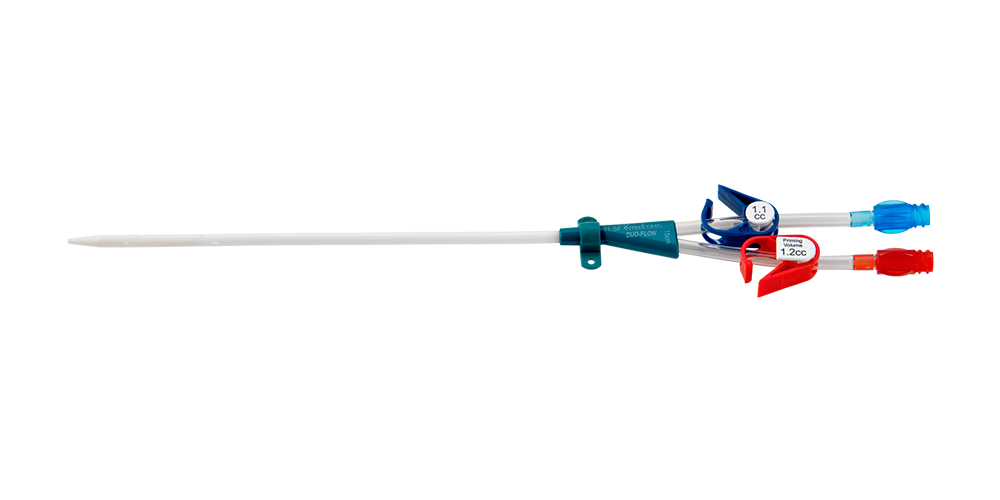
Device Name: Duo-Flow® Catheter
Description of Device: The Duo-Flow® Catheter has
two separate paths to move blood in and out of the body. Each path
has a different colored tube. The tubes connect to a part that is
shaped like a hub. Both paths have small holes to help the blood
flow. The device contains a substance called Barium Sulphate to
make it easier to see with X-rays. It comes in various sizes and
shapes to fit the needs of the patient as determined by the
doctor.
Device Name: Duo-Jet® Catheter Nikkiso Duo-Flow®
Catheter
Description of Device: The Duo-Jet® Catheter has
two separate paths to move blood in and out of the body. Each path
has a different colored tube. The tubes connect to a part that is
shaped like a hub. Both paths have small holes to help the blood
flow. The device contains a substance called Barium Sulphate to
make it easier to see with X-rays. It comes in various sizes and
shapes to fit the needs of the patient as determined by the
doctor. Nikkiso Duo-Flow® Catheter The Nikkiso Duo-Flow® Catheter
has two separate paths to move blood in and out of the body. Each
path has a different colored tube. The tubes connect to a part
that is shaped like a hub. Both paths have small holes to help the
blood flow. The device contains a substance called Barium Sulphate
to make it easier to see with X-rays.
Materials / Substances in Contact with Patient Tissue:
The percentage ranges below are based on catheter weights. The
11.5F x 12cm catheter weighs 10.21 grams. The 11.5F x 24cm
catheter weighs 11.75 grams.
11.5F Duo-Flow
| Material |
% Weight (w/w) |
| Polyurethane |
42.96-47.81 |
| Acetal co-polymer |
20.40 - 23.47 |
| PVC |
15.83-18.22 |
| ABS |
6.25 -7.20 |
| Vythene |
5.04 -5.80 |
| Barium sulfate |
2.35-4.66 |
The percentage ranges below are based on catheter weights. The 9F
x 12cm catheter weighs 9.81 grams. The 9F x 20cm catheter weighs
10.41 grams.
9F Duo-Flow
| Material |
% Weight (w/w) |
| Polyurethane |
41.56-43.79 |
| Acetal co-polymer |
23.02 - 24.43 |
| PVC |
17.86-18.96 |
| ABS |
7.06 -7.49 |
| Vythene |
5.69-6.04 |
| Barium sulfate |
1.51-2.59 |
Note:The device should not be used if you are allergic to the
above materials.
Information on Medicinal Substances in the Device:
N/A
How the Device Achieves its Intended Mode of Action:
Hemodialysis tubes provide access through the vein or artery. The
tube is thin and flexible and goes into a big vein near the center
of the body. There are two openings in the tube. One opening takes
out the blood and sends it to a machine that cleans it. The other
opening puts the clean blood back into the body. This tube is used
when someone needs to have their blood cleaned right away, and
they can't use a different kind of tube. This tube is only used
for a short time.
Cleaning (Sterilization) Information: Contents
are clean and will not cause fever in unopened, undamaged package.
Sterilized by Ethylene Oxide.
Accessories Intended for Use in Combination with the
Device:
| Name of Accessory |
Description of Accessory |
| Guidewire |
Acts as a path for other components. |
| Guidewire Advancer |
Helps guidewire introduction. |
| Introducer Needle |
Placed into the target vein to gain access.
|
| Scalpel |
A cutting device. |
| Dilator |
Used to make the opening of a vessel larger.
|
| End Cap |
To keep the catheter clean between treatments.
|
| Syringe |
Helps get blood return once the needle punctures the vein.
|
4. Risks and Warnings
If you think something is wrong with how you feel after using the
device or you're worried about any problems, talk to your
healthcare professional. Remember, this information is not meant
to take the place of talking to your doctor if you need to.
How Potential Risks Have Been Controlled or Managed
There have been 208,951 devices sold since January 2019. There are
side effects and risks associated with the device. These include:
Infection
Bleeding
Tube Removal
Tube Replacement
These risks are reduced to an acceptable level. The labeling
describes the risks. The benefit of the device is access for
hemodialysis when alternatives are not suitable. These benefits
outweigh the risks.
Remaining Risks and Undesirable Effects
The Duo-Flow® catheter is associated with risks. These include:
Procedural Delays
Blood clots in veins (Thrombosis)
Infections
Punctures in organs (Perforations)
Air bubbles in veins (Embolism)
Heart problems (Cardiac Event)
Feeling unhappy with the procedure (Dissatisfaction)
The risks of using the Medcomp device are similar to other
dialysis tubes. The most common problem is getting an infection.
Infections can happen when someone has surgery or stays in the
hospital. Infections are not always caused by use of the device.
The below tables includes events that can happen when the tube is
put in, used, or taken out. Not all device problems are reported.
|
Quantification of Residual Risks
|
|
PMS Complaints (01 January 2017 – 31 December 2023)
|
PMCF Events |
|
Units Sold: 245146 |
Units Studied: 29 |
|
Patient Residual Harm Category
|
# of Cases Per Event |
# of Cases Per Event |
| Allergic Reaction |
Not Reported |
Not Reported. |
| Bleeding |
1 Event in 245,000 Cases. |
Not Reported. |
| Cardiac Event |
Not Reported. |
Not Reported. |
| Embolism |
Not Reported. |
Not Reported. |
| Infection |
Not Reported. |
1 Event in 5 Cases. |
| Perforation |
Not Reported. |
Not Reported. |
| Stenosis |
Not Reported. |
Not Reported. |
| Tissue Injury |
Not Reported |
Not Reported |
| Thrombosis |
Not Reported |
1 Event in 9 Cases. |
Warnings and Precautions
The below are warnings, precautions, or measures to be taken by
patient:
To keep germs away from the catheter, wear a mask over your nose
and mouth every time the catheter is used.
Keep the catheter dressing clean and dry. The dressing should be
changed by a medical professional at each dialysis session.
Avoid getting the catheter or catheter site wet. Moisture near the
catheter site can cause infection. Ask the doctor to explain the
signs and symptoms of catheter infection.
Never remove the cap at the end of the catheter. The cap and
clamps of the catheter must be kept closed when not being used for
dialysis.
Summary of Any Field Safety Correction Action (FSCA)
There were no recalls for the device between 01 January 2023 to 31
December 2023.
5. Summary of Clinical Evaluation and Post-Market Clinical
Follow-Up
Clinical Background of Device
The Duo-Flow® catheter has been available since 1984. The CE Mark
was received in March 2001. US FDA clearance was in July 1984. All
models included are planned for distribution in the European
Union.
Clinical Evidence for CE-Marking
The clinical literature review identified 13 articles relating to
the safety and/or performance of the subject device when used as
intended. These articles included approximately 505 cases. Three
patient level data activities received information on 29
catheters. Findings from the clinical literature and data
activities support the performance of the subject device. All data
on the Duo-flow® catheter has been evaluated. When you use the
device as intended, the good things it does are more than the bad
things it might cause. This device helps people who have kidney
problems get hemodialysis when other treatments are not right for
them.
Safety
There is sufficient data to prove conformity to the applicable
requirements. The device is safe and performs as intended and
claimed by Medcomp. The device is state of the art for allowing
short-term vascular access for hemodialysis in adult patients.
Medcomp has reviewed:
Post-Market Data
Medcomp Information Materials
Risk Management Documentation
The risks are appropriately displayed and consistent with the
state of the art. The risks associated with the device product
family are acceptable when weighed against the benefits. There
were 94 complaints for 208,951 units sold from 01 January 2019 to
31 December 2023. The complaint rate is 0.045%.
6. Possible Therapeutic Alternatives
When considering alternative treatments, it is recommended to
contact your healthcare professional who can consider your
individual situation. The Kidney Disease Outcomes Quality
Initiative (KDOQI) 2019 clinical practice guidelines have been
used to support the below recommendations for treatments.
| Therapy |
Benefits |
Disadvantages |
Key Risks |
| AV Fistula |
- Permanent solution.
-
Lower complication rate than catheter.
|
- Requires time.
-
Patients must sometimes self- needle stick.
|
- Narrowing of a vein (Stenosis)
- Thrombosis
-
Bulge in a blood vessel (Aneurysm)
-
High blood pressure in the lungs (Pulmonary
hypertension)
-
Lack of blood flow to an area (Steal Syndrome)
- Blood infection (Septicemia)
|
| Hemodialysis Catheter |
- Useful for quick access.
-
Can be used as a bridge between therapies.
|
- Not permanent.
- Catheter dysfunction can happen.
-
Benefit may not be the same for everyone.
|
- Post-procedural bleeding
- Infection
- Thrombosis
-
Decreased blood flow in dysfunctional catheter
- Cardiovascular events
-
Fibrin sheath formation around catheter
- Septicemia
|
| Peritoneal Dialysis |
-
Less restrictive diet than hemodialysis.
- Does not require hospitalization.
|
-
Clearance of impurities is limited by flow and space.
|
-
Infection of the abdomen (Peritonitis)
- Septicemia
- Fluid overload
|
| Kidney Transplant |
- Better quality of life.
- Lower risk of death.
- Fewer food restrictions.
|
- Requires a donor.
- More risky for certain groups.
-
Patient must take medication for life.
|
- Thrombosis
- Severe bleeding (Hemorrhage)
-
Blockage of the tubes that carry urine (Ureteral
blockage)
- Infection
- Organ rejection
- Death
-
Heart problem (Myocardial infarction)
-
Blocked blood flow to brain (Stroke)
|
| Comprehensive Conservative Care |
- Less imposed symptom burden.
- Preserves life satisfaction.
|
- May aggravate clinical condition.
- Not designed to treat.
|
-
Treatment may not actually minimize risks associated
with CKD.
|
7. Suggested Profile and Training for Users
The catheter should be inserted, manipulated, and removed by a
qualified, licensed physician or other qualified health care
professional under the direction of a physician.
Acronyms
| Abbreviation |
Definition |
| AKI |
Acute Kidney Injury |
| AV |
Arteriovenous |
| CE |
Conformité Européenne (European Conformity)
|
| CKD |
Chronic Kidney Disease |
| cm |
centimeter |
| CMR |
Carcinogenic, mutagenic, reprotoxic |
| CVC |
Central Venous Catheter |
| EU |
European Union |
| F |
French (thickness of catheter) |
| FDA |
Food and Drug Administration |
| FSCA |
Field Safety Corrective Action |
| HD |
Hemodialysis |
| KDOQI |
Kidney Disease Outcomes Quality Initiative
|
| PA |
Pennsylvania |
| PMCF |
Post Market clinical follow-up |
| PMS |
Post Market Surveillance |
| SSCP |
Summary of Safety and Clinical Performance
|
| STHD |
Short-term Hemodialysis |
| USA |
United States of America |
| w/w |
Weight over Weight |